The sit gets all the attention. But by the time a dog performs its trained final response, the important work is already done. Understanding the search as a sequence of phases lets a handler see the investigation as it happens — and describe it accurately later.
Detection — working the search
In short
The Latimer Five-Phase Model describes a detector-dog search as: responds to the search command, systematic search, detection, change of behavior, and trained final response. Phases three and four are the investigation — where the dog actually solves the problem — and naming them lets a handler observe, document, and testify precisely.
Where this model comes from, and what it is not
This is a working model, and it is worth saying so plainly. Research on detection dogs supports the pieces it is built from: that behavior occurring before the trained response carries usable information, and that dogs measurably change how they move as they localise a source. What no published study has yet done is validate that every search divides into these exact five phases, or that two observers watching the same dog would draw the boundaries in the same place.
So this is the Latimer Five-Phase Model — a framework built in the field over twenty-five years, consistent with the research but not a finding of it. That distinction matters more here than in most training material. A handler who testifies that the dog moved through “the five scientifically established phases of canine detection” has handed the other side an easy afternoon. A handler who says “I use a five-phase framework to describe what I observed, and here is what the dog actually did” is describing evidence, and is much harder to move.
Why phases instead of just “the alert”
A detector dog doesn't recognize odor at the instant it sits. Recognition happens earlier, and the dog's behavior changes as it works the problem. Breaking the search into phases gives handlers a shared, precise language for what the dog is doing — instead of collapsing an entire investigation into one word: “alerted.”
The five phases
Phase 1 — Responds to the command to search. The dog begins working on cue.
Phase 2 — Systematic search, no target odor recognized. The dog covers the area methodically.
Phase 4 — Change of behavior. The observable tell: respiration, head position, body tension, bracketing toward source.
Phase 5 — Trained final response. The dog reports its conclusion. The sit is phase five — not the whole story.
Commitment — driving to source
Phases 3 and 4 are the investigation
This is where the dog actually does its work, and it's exactly what most testimony leaves out. A handler who can say what happened in phases 3 and 4 — “the dog stopped forward movement, raised its head, turned into the wind, and bracketed the passenger door” — is describing evidence. A handler who can only say “my dog alerted” has skipped the investigation.
A search, phase by phase
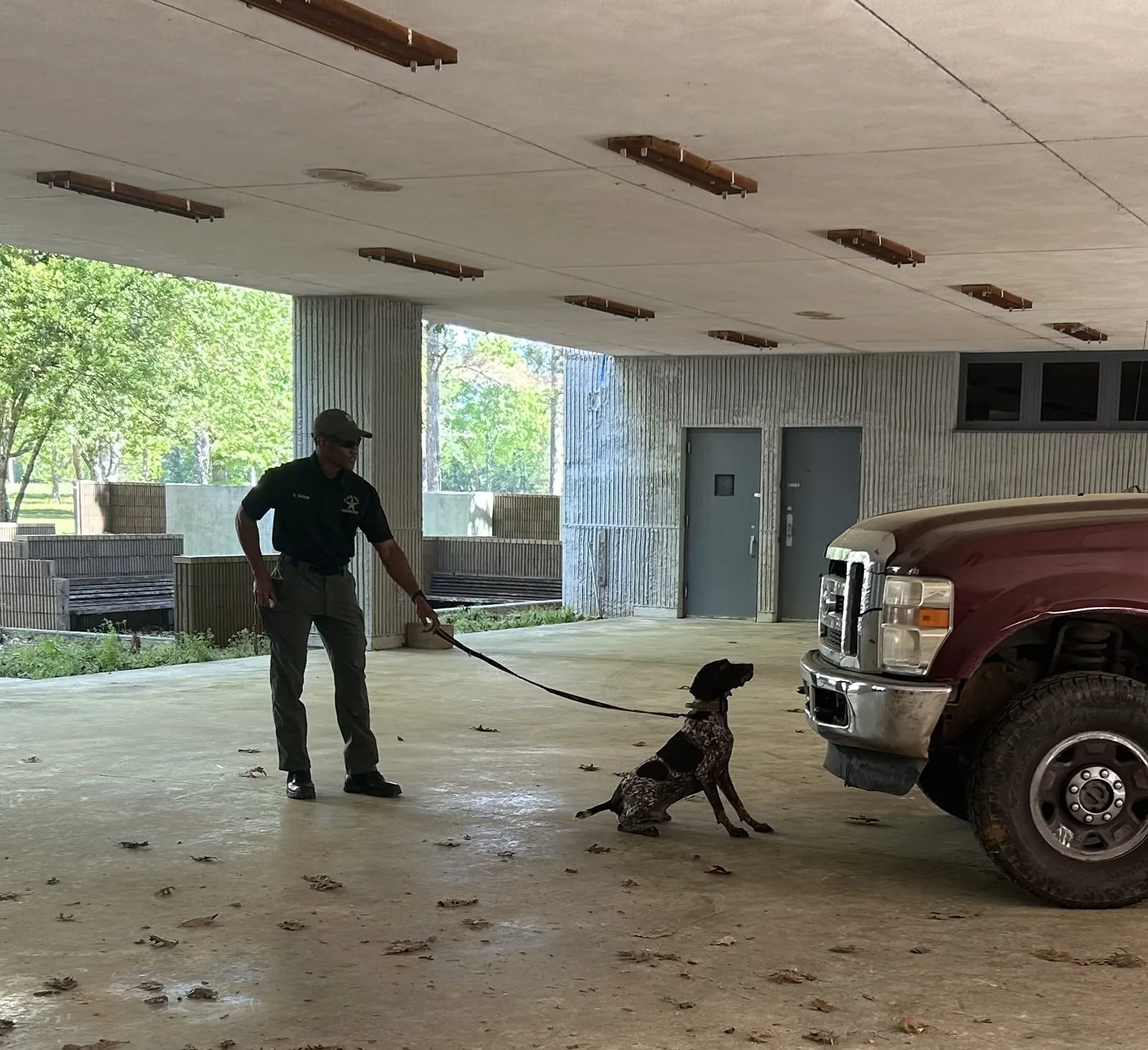
Watch a real search and the sequence stops being abstract. You send the dog — phase one, a clean start line, everything after it on the record. The dog begins working the room methodically, checking seams and corners, using the air — phase two, the honest labor of eliminating negative space, which looks like nothing is happening but is the dog doing exactly its job.
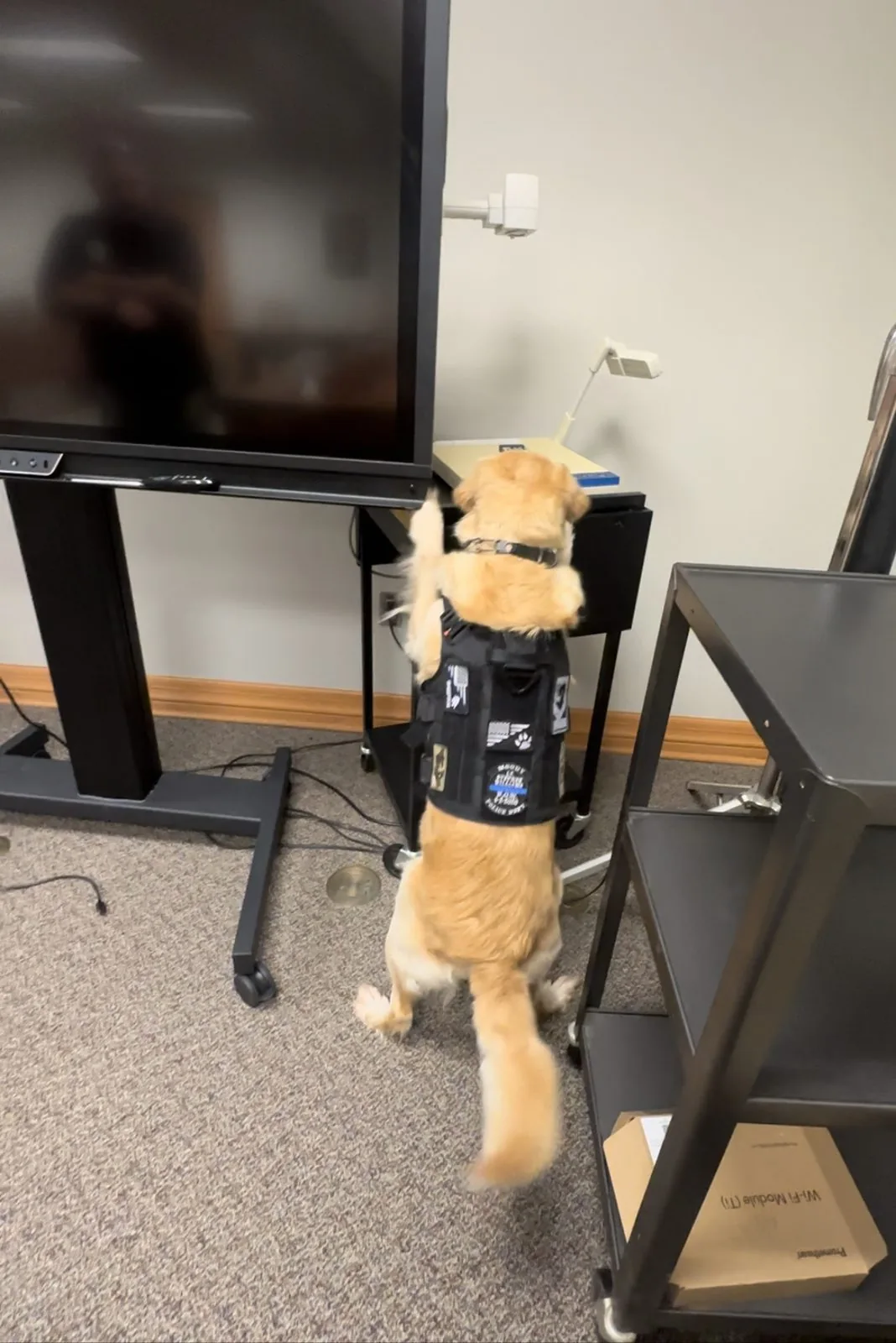
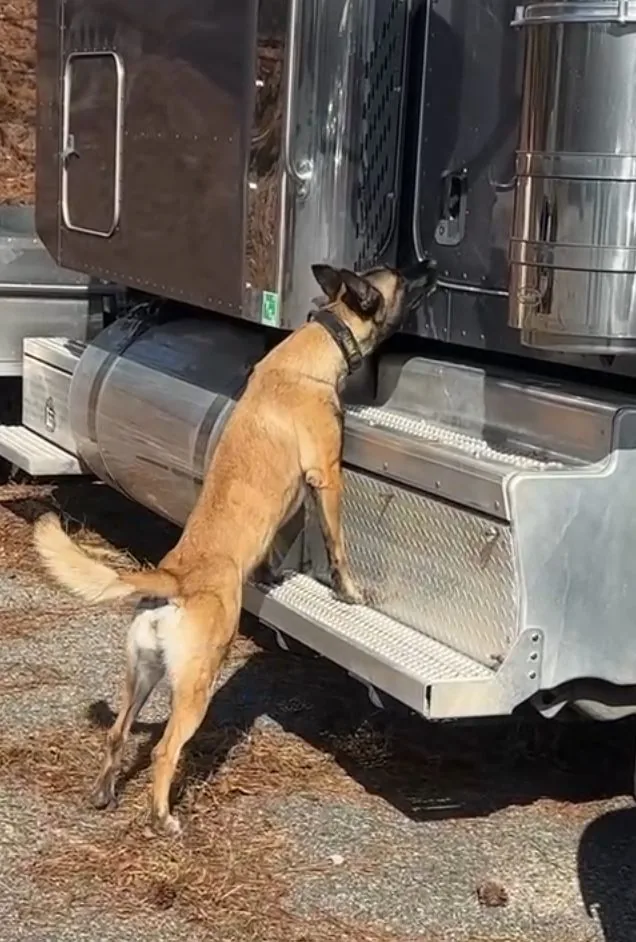
Then it crosses a scent cone and something registers. The first tell is almost always the breath: the open, cooling pant closes into short, rapid sniffs as the dog samples. That is phase three — detection — and it is subtle and fast and the reason most handlers miss the real moment of the find. Now the dog commits: the head drops to a seam or lifts into a current, the tail changes, the footwork tightens into bracketing as the dog works the edges of the odor and drives toward the strongest concentration. That is phase four, the change of behavior, and phases three and four together are where the dog actually solves the problem. The sit that follows is phase five — the dog reporting a conclusion it reached seconds earlier.
Response — at source
Reading the change of behavior
Phase four is the one worth studying, because it is where the evidence lives and because no two dogs perform it the same way. One dog's change of behavior is a dramatic head-snap; another's is a barely perceptible drop in the tail and a shift in cadence. That is why there is no universal checklist — there is only your dog and the baseline you have learned by watching it work clean searches, so you know what normal looks like the instant it stops being normal.
Respiration — the open pant closing into deliberate sampling is often the first and clearest tell.
Head position — where the dog is placing the problem: up into a current, down at a seam, snapping back to a source it overran.
Tail carriage — a change in height, tension, or speed at commitment; for your dog it may be the opposite of the textbook, which is why baseline is everything.
Footwork — bracketing back and forth across the plume, overshooting and correcting, then the hard drive to source.
Training to the phases
Once you see the search as a sequence, you stop drilling the sit and start coaching the whole thing. You reward the investigation — the searching and bracketing and honest problem-solving — instead of getting so fixated on the final response that the dog learns to rush to it. And you build in the honest “no odor here,” because a dog that believes every search must end in a find will eventually manufacture one. A dog that can clear a blank area confidently is a dog whose alert means something.
The phases on the witness stand
This is where naming the phases pays off in the only room that ultimately counts. On the stand, the strongest thing a handler can do is describe what the dog did and stop there — keep observation and interpretation in separate sentences. “The dog's respiration changed, it snapped back to the seam of the trunk, bracketed twice, and sat” is an observation a handler can defend. “The dog knew there were drugs in the car” is an interpretation a good attorney will take apart, because the dog knows odor, not law. A handler who can narrate the phases testifies to behavior — precise, bounded, honest — and that testimony holds up precisely because it does not overreach.
Frequently asked
Is the trained final response unimportant?
Not at all — it's how the dog reports its conclusion. The point is that it's the end of the sequence, not the entire event. The behavior leading up to it is what makes it meaningful.
Where does this come from?
It's part of the LSOC approach developed by David Latimer, a retired chief of police and FBI National Academy graduate, and set out in his forthcoming book.
Watch
The phases, on film.
Handling, how not to teach a dog to go to source A common error, shown rather than described.Handling, minimal direction and teaching source Letting the dog solve it instead of steering it.